Does adding a one-time purchase option raise conversion on a subscription page?
Written from hands-on work in: Shopify conversion rate optimization, Landing pages and advertorials, A/B testing, Checkout and subscription offers, Supplement DTC funnels.
Short answer
In our live 50/50 test on a 9-figure US supplement brand, adding a one-time option next to a preselected Subscribe and Save plan lifted conversion rate, revenue per visitor and average order value in the first read. The read is early and every extra order so far is one-time, so we score it on subscriptions and 60-day revenue per visitor before calling it.
Key takeaways
- A subscription-only page only sells to visitors ready to commit on the first visit. A one-time option is a second door for everyone else, not a replacement for subscription.
- We kept the brand's model intact: Subscribe and Save stays preselected and keeps the free gifts, and the one-time plan sits beside it at a higher price with no gifts.
- First read on the version with the one-time option: +176% conversion rate, +293% revenue per visitor and +42% average order value. It comes from the first hours of the test, so it is a direction, not a verdict.
- Conversion rate is also a CPA lever: at the same cost per click, a 20% conversion lift means a 17% lower cost per purchase.
- The test is decided by subscriptions per visitor and 60-day revenue per visitor, because a one-time buyer pays once and a subscriber keeps paying.
- At Succession we test inside the brand's strategy, not against it: one narrow question, one traffic source, one scoreboard agreed before launch.
Why test a one-time option on a subscription-first brand?
This brand sells subscription first. Its main paid landing page offers one plan, Subscribe and Save with free gifts, and that model works. It is not ours to argue with. Our job at Succession is to grow it while moving conversion rate and cost per purchase in the right direction together.
One paid traffic source was the reason for this test. It sends a large share of the page's visitors, its cost per purchase ran about 12% above the account average over seven days, and on the same page it converted about 30% below the brand's best source.
Same page, same offer, about a third fewer buyers. That pattern usually means part of the traffic wants the product but not the commitment. On a subscription-only page those visitors get one door, and it is closed to them.
Subscription vs one-time purchase: what does each one win?
A one-time purchase is a single order with no recurring charge. Subscribe and Save is a recurring order at a discount, billed on a schedule until the customer cancels. They win different things, so the real question is rarely subscription or one-time purchase. It is how to offer both without losing what each one is good at.
| One-time purchase | Subscribe and Save | |
|---|---|---|
| What the buyer commits to | One order | Repeat orders until they cancel |
| First-order conversion | Usually higher: nothing to commit to | Usually lower on cold traffic |
| Value of the first order | Higher: no subscription discount | Lower: discounted |
| Lifetime value | One payment unless they come back | Repeats every cycle while they stay |
| Best fit | Cold, skeptical or gift buyers | Repeat users of a product they already trust |
| Main risk | Pulls buyers away from subscribing | Loses buyers who will not commit |
Order and default matter as much as having both. In an A/B test across 13 merchants, placing the subscription offer above the one-time option lifted subscription enrollment by 11% on average, and by up to 63% for some (Ordergroove). In our test, Subscribe and Save is listed first and preselected in both versions.
How we set up the subscription vs one-time purchase A/B test
We built the variant as an exact copy of the live page and changed one thing: the plan selector.
| A: subscription only (control) | B: plus a one-time option | |
|---|---|---|
| Plans shown | Subscribe and Save | Subscribe and Save, Buy Once |
| Default selection | Subscribe and Save | Subscribe and Save |
| Free gifts | Included | Subscription only |
| One-time price | Not offered | About 18% above the subscription price |
| Page, copy, reviews, checkout | Unchanged | Unchanged |
- One traffic source only. The split runs on a single paid campaign, so the result is not blended with sources that convert differently.
- Only visitors who land on the page from an ad. Visitors routed in from another page are left out, so nobody sits in two page tests at once.
- A 50/50 split in Intelligems. Half of those visitors see the variant page. Every other source keeps the live page.
- A scoreboard agreed before launch. Revenue per visitor and subscriptions per visitor first, conversion rate second, and 60-day revenue per visitor with renewals as the final check.
- A read at a fixed sample. About a week of traffic, not the first good-looking hour.
What did the first read of the A/B test show?
The first read came in within the first hours of the test. On the version with the one-time option, all three headline metrics moved up.
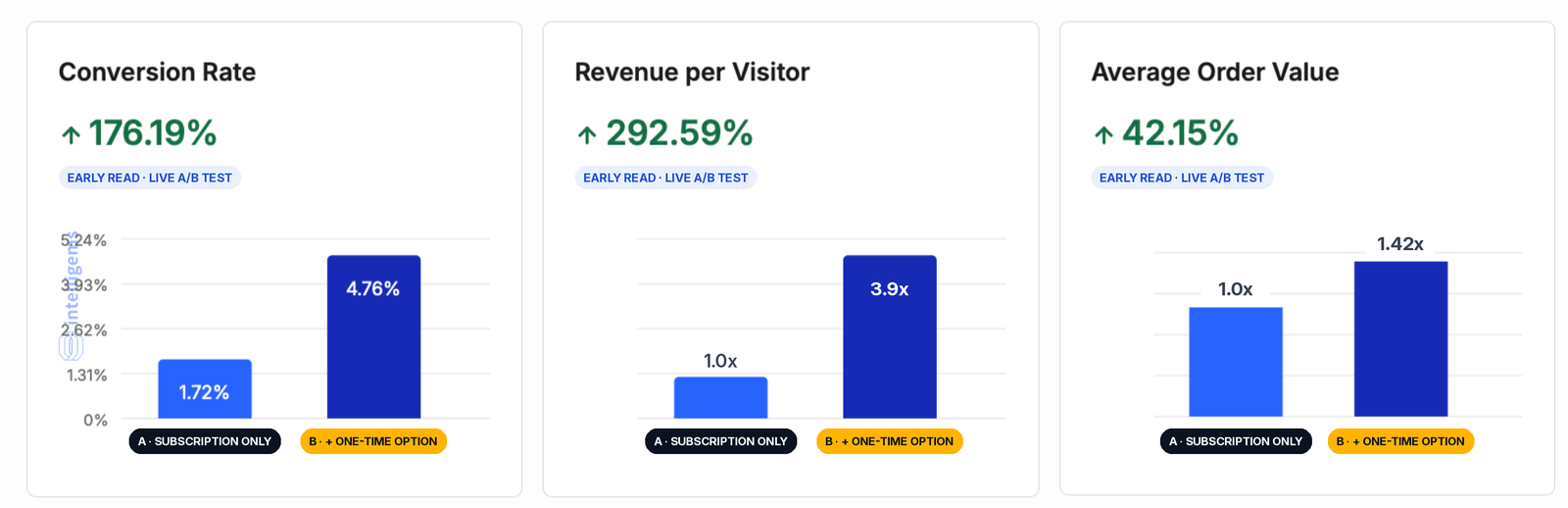
| Metric | First read | Latest read |
|---|---|---|
| Visitors in the test | About 120 | 193 |
| Conversion rate | +176% | +68% |
| Revenue per visitor | +293% | +111% |
| Average order value | +42% | +25% |
Two things to take from this, and one thing not to:
- The direction is consistent. Conversion rate, revenue per visitor and order value all point the same way on the variant, in both reads.
- Part of the order value lift is built in. The one-time plan is priced above the subscription, and one buyer added a second unit at checkout.
- Do not call it yet. In the first hours of a test, a single order moves conversion rate by more than a point. Between the two reads the conversion lift went from +176% to +68%. That is exactly why we read at a fixed sample.
Why can a one-time option lift conversion rate, revenue per visitor and AOV?
- It removes the commitment objection. Some visitors will try a product but will not sign up for recurring charges on a first visit. A subscription-only page gives them nothing to say yes to.
- It makes the subscription look like the deal. With a one-time price beside it, the subscription price reads as the saving. Most vitamin brands already sell this way: in a 12-brand teardown, 9 preselect subscription and 10 show the one-time price struck through (Yocto).
- It cuts checkout surprises. When the only option is recurring, some buyers notice the terms at checkout and leave. A visible choice on the page sets the expectation earlier.
- It raises first-order value. A one-time plan priced above the subscription lifts order value on every one-time order, and checkout add-ons still apply.
Conversion rate is also a cost-per-purchase lever. Cost per purchase equals cost per click divided by conversion rate, so at the same click cost a 20% conversion lift means a 17% lower cost per purchase. That is why we read conversion rate and CPA side by side, not as two teams' separate problems.
When does a one-time option cost you money?
When it moves buyers from subscription to one-time instead of adding new buyers. A subscriber keeps paying; a one-time buyer pays once. RecurX estimates that "a subscriber who stays 12 months is worth four to six times a one-time buyer at the same order size" (RecurX).
| Assumption | Value |
|---|---|
| Subscription price | 100 (index) |
| One-time price | 118 (18% higher) |
| Average subscriber lifetime | 3 orders, so 300 |
| Revenue lost when one subscriber switches to one-time | 300 minus 118 = 182 |
| New one-time buyers needed to cover that switch | 182 / 118 = about 1.5 |
In that example, every subscriber who downgrades has to be offset by about one and a half brand-new one-time buyers. Your break-even depends on your own retention, which is why a test like this is read on subscriptions per visitor and on revenue per visitor over 60 days, not on the first order alone.
How we score a subscription offer test at Succession
| Metric | Role | Why |
|---|---|---|
| Revenue per visitor, first order | Primary | Conversion rate and order value in one number |
| Subscriptions per visitor | Primary | Protects the brand's subscription model |
| Conversion rate | Secondary | Explains the move and drives cost per purchase |
| 60-day revenue per visitor, renewals included | Final check | Shows whether one-time buyers cost future revenue |
| Refunds and cancellations per order | Guardrail | Catches buyers who regret the purchase |
We set the sample before launch and read the test at that point, not when a chart looks good. We will update this page with the full read.
Should you add a one-time option to your subscription page?
Test it if most of these are true:
- Your main paid landing page sells subscription only.
- One traffic source converts well below the others on the same page.
- Buyers reach checkout and leave once they see the recurring terms.
- You can measure subscriptions and 60-day revenue per visitor for each test arm.
Skip it, or test with extra care, if your subscribers already churn after one or two orders, or if your margin cannot carry a one-time price close to the subscription price. Our guide on the right Subscribe and Save discount covers the pricing side, and a week inside this brand's CRO program shows how we read every test.
FAQ
What is the difference between a subscription and a one-time purchase?
A one-time purchase is a single order with no recurring charge. A subscription, such as Subscribe and Save, repeats the order on a schedule at a discount until the customer cancels. One-time purchase usually wins the first order; subscription usually wins lifetime value.
Is subscription or one-time purchase better for a DTC brand?
Usually both. One-time purchase tends to win the first order with new or skeptical visitors, and Subscribe and Save wins lifetime value with repeat users. Offer both, keep subscription as the default, and judge the mix on revenue per visitor and 60-day retention, not take rate alone.
Should the subscription option be listed above the one-time purchase?
In most cases, yes. In an A/B test across 13 Ordergroove merchants, placing the subscription offer above the one-time option raised enrollment by 11% on average. In our test, Subscribe and Save is listed first and preselected in both versions.
Does offering a one-time purchase reduce subscriptions?
It can. Some buyers who would have subscribed choose one-time instead. The test is whether the option adds enough new buyers to beat that loss, so measure subscriptions per visitor and 60-day revenue per visitor for each test arm, not take rate alone.
Should Subscribe and Save be preselected?
In our test it stays preselected in both versions, so the only change is the presence of a one-time choice. Preselection is common: 9 of 12 vitamin brands in one teardown open with subscription selected. Keep the terms clear and the one-time option visible.
What should the one-time price be compared with the subscription price?
High enough that the subscription reads as the better deal, not so high that the one-time option looks like a decoy. In this test the one-time price sits about 18% above the subscription price, and the free gifts stay with the subscription.
How long should a subscription offer A/B test run?
Until the sample you set before launch, and at least a full week so every weekday is covered. Read first-order results then, and check 60-day revenue per visitor once renewals start billing.
Which metric decides a subscription offer test?
Revenue per visitor and subscriptions per visitor together. Conversion rate alone can rise while lifetime revenue falls, if the extra orders are one-time buyers who would have subscribed.
Does a higher conversion rate lower CPA?
Yes, at the same cost per click. Cost per purchase equals cost per click divided by conversion rate, so a 20% conversion lift on the same traffic cuts cost per purchase by about 17%.
When to bring in Succession Media
Succession Media is a DTC growth agency for Shopify brands doing $20K+ a month, strongest in supplement, wellness and health categories. This guide's topic maps to our Media Buying and CRO work. It is worth a call if:
- Your landing page sells subscription only and one paid source converts well below the rest.
- Your cost per purchase keeps climbing and you suspect the offer, not the ads.
- You have never tested subscription only against subscription plus one-time on the same traffic.
- You cannot tell whether a winning test raised first-order revenue or lifetime revenue.
Sources
How we researched this guide
This guide reports a live Intelligems A/B test we run for an anonymized 9-figure US supplement brand that sells subscription first. The brand, products, page names and prices are not shown: figures are rates, percentage changes and indexes, US traffic only. The first read is not statistically significant, and we will update this page with the full read. Last reviewed .

Co-Founder, CRO and Landing Pages, Succession Media
CRO and landing-page architect for 7 and 8-figure DTC brands. Runs the strategy call, the funnel teardown, and the weekly testing loop that turns spend into profit.
Related guides
- Shopify CROWhat Subscribe and Save Discount Should a Supplement Brand Offer?
- Shopify CROA week inside the CRO program of a 9-figure US supplement brand
- Shopify CROIntelligems vs Shoplift: Which Shopify A/B Testing Tool, and How Much Traffic Do You Need?
- DTC GrowthWhat LTV to CAC should a subscription supplement brand aim for, and how fast should it pay back?